FactBox

Monday, 28 November 2011

The thing in the loft

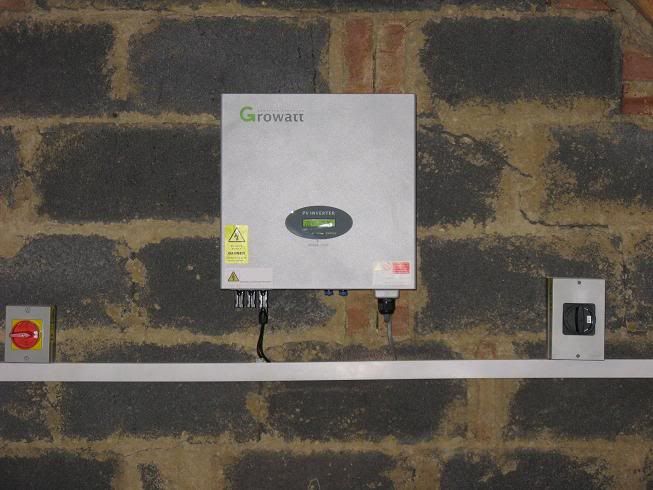
By way of finishing the description of the system, I’d thought I’d better include a photo of the inverter which is mounted in the loft. This is Growatt 4400 unit, capable of handling about 4400W of power generation shared over three different array circuits. Whilst my current system is wired as a single daisy-chain of panels, it is nice to know that should I need to, I can split the array, or add further arrays in the future. This is of particular relevance should I decide to extend the house and/or have a loft conversion requiring a large dormer on the back of the house.
The unit itself is in the loft for a few reasons – it is out of the way, it is nice and cold (which improves efficiency) and it’s at the right end of the repurposed 13amp feed from the fuse board.
In all it’s a fairly uninspiring looking device, but it is heavy (about 20kg) and I suspect it’s just a huge transformer (or transformer equivalent) and a giant heatsink. According to the technical data, it is 98% efficient and has a power consumption of less than 5watts once output from the panels drops (i.e. at night).
One nice touch is the display. The two line LCD cycles through a variety of useful information input/output voltage, power, kWh per day etc. which is most informative. In order to make reading easier you simply knock gently on the case and the display become backlit for 30 seconds or so.
Given the remote location of the inverter, I really don’t expect I’ll be checking on it with any regularity. But that’s where the OWL monitor and the generation meter under the stairs come into their own.
Hopefully by next week I’ll have a few initials statistics to share, so it’ll be interesting to see how the first 7 days have gone.

Friday, 25 November 2011

A good day forecast

Today is the first day since the system went live that we have a great weather forecast - clear skies & lots of sun all day. So I'm expecting a record day.

By 0830 it was clear that the forecast was living up to its promise and the system was already pumping out a very healthy 700watts of juice.

In fact, a quick glance under the stairs showed that for the first time that I had observed, the main electric meter was complaining about trying to go backwards. I dont think it does, only that it glows and complains with an error message. This may have occurred before, but I was not around to witness it.

Shortly after, the family started moving about and the illusion was gone - on went the TV, laptop etc. and suddenly we were no longer self-sufficient, but that should all change as the sun increases strength around lunchtime.

Here's hoping I will be recording our best ever generation figures by the end of the day.

Postscript: 4.468 kWh produced today, beating the previous high of 3.377 kWh. Not bad for a nice day at the tail end of November.

Wednesday, 23 November 2011

Payback time

There were many reasons why I decided to have the solar panel system installed. But whilst trying not to completely discredit my green credentials, a significant element is the financial story.
For systems installed and registered prior to Dec 12th this year, there is a generous Feed In Tariff (FIT) of 43.1p per unit generated and then additional advantages in terms of electricity usage to offset and revenue from exporting excess power in the summer.
The various companies that I asked to quote for the project all included standard pay back calculations, but frankly these seemed too good to be true and also lacking in practical factors. (In fact it is too good to be true, and why the government if halving the FIT going forward, for once I have the timing just right.)
Having some experience of financial modeling of my own, in the preparation of business cases etc., I decided to design my own payback calcs by way of checking the figures.
The main elements are very simple, but are based around comparing the outlay, return and the potential value of return against what the investment could achieve if left in a safe place. The problem with most calculations I’ve seen is that they:
  1. Do not consider that the investment would earn interest if not spent on solar pv. (Financial folks might start talking about NPV at this point, but since I’m not sure this is the correct term, I will refrain from this). 
  2. Do not consider that the FIT income could be invested on receipt
  3. Do not acknowledge that there is a difference between return on investment and interest on a lump sum, whilst retain the lump sum, which have different levels of utility.
The latter point is very important when looking at the cash flow concerned and determining an AER equivalent for the 25 year period.
So, based on the spreadsheet I have received, I built a very simple payback calculator to determine real payback based on interest lost, cash flow and comparative position vs the lump sum investment.
To simplify the model I’ve rolled the various cumulative effects into a single RPI factor, i.e. panel degradation, electricity cost, FIT payment increase. Overall this worked out at 3.0% annual increase in benefit. To simplify the model I have assume I can obtain a 3% risk free rate of return for both the lump sum and FIT payments. I have chosen to model the cash flow on the FIT payments alone. This was for two reasons: Firstly, I will probably only notice the FIT payments since they represent the bulk of income and secondly, the FIT payments will be ring fenced into a separate nest egg for my kids. Hopefully by the time they are old enough this will be sufficient to make a hole in university fees or mortgage deposit.
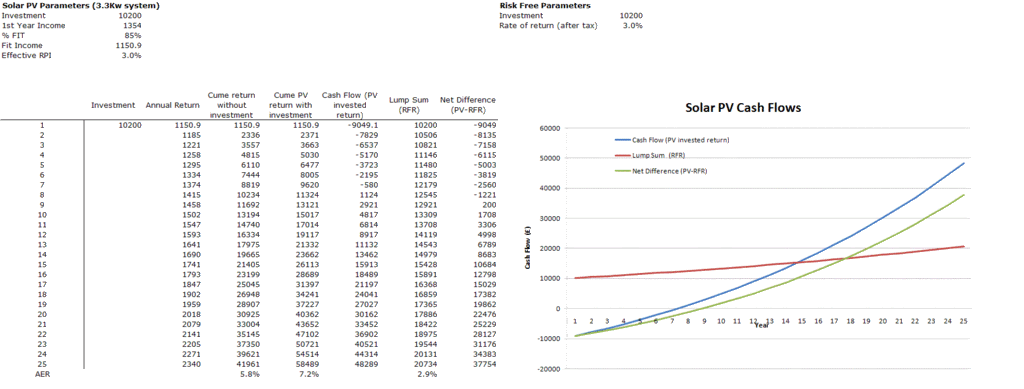
The analysis below shows the comparison between cash flow (return - investment) allowing for interest, the lump sum return and the difference.

The quoted payback on the system from the official spreadsheets is said to be, typically, 8 years. However this is the point at which the system cost is recouped. You haven’t at this point made any profit, and you haven’t allowed for interest you would have earned in the mean time.
Allowing for potential return you can see from the model that although you recoup you investment at about 7.5 years, you only match what the lump sum would achieve at 9 years. (The point at which the green line goes positive).
However, overall it’s good news. Over the 25 years, with reasonable reinvestments and a RFRoR of 3%, the initial outlay should create a nest egg of over £58k. This is nearly £38K more than the outlay of £10K would have generated at a 3% p.a. return.
Whilst this sounds like a lot, you need to bear in mind that inflation will significantly reduce the value of £58K in 25 year’s time – however, it should at least be equivalent to £20K in today’s money.
It was this analysis that prompted me to move forward with the project. I think it’s a more fair reflection of the investment return than the calcs from the various vendors. But then that’s just me.
Tuesday, 22 November 2011

A little progress

Four days in and the weather's been pretty poor - two days of fog followed by a dank, drizzly day. Still managed to produce a few units of power, but nothing amazing. The grand total for the four days is just 8.0 kWh, but it's a start. 

In the mean time, my MCS certificate arrived my email on Sunday and the necessary forms etc. were sent off Monday by recorded delivery. These were duly received today (Tuesday) is the Royal Mail delivery tracking website is to be believed. 

Quite why it is necessary to have an 8-page form to register ones panels with your electricity supplier is beyond me - especially when they already take money off me every month without any such detail - but it's a necessary evil, so one just moves on.

So hopefully all is coming together nicely. 

On the 'to do' list now are just a few minor things:

(1) chase up the scaffolding, I was hoping it would go early this week

(2) follow up on the warranties for the kit

(3) sort out some savings accounts of the kids - the plan is to put all FIT payments into a nest egg for the kids, so I need to make a few changes here to get more than token interest. This item is less urgent, since I'm not expecting to see any cash for a little while, but I like to be prepared.


Saturday, 19 November 2011

Watts at last

So today was the first day of generating real electricity. 

About 8am the OWL meter started to show about 120W - more than the background reading of 85W that seems to persist throughout (presumably the load of the inverter and panels). By 9am things had started to lift up to 500W or so and by 10am we'd seen upwards of 700W on several occasions.

The weather was not ideal - grey cloud clearing later, but from time to time the sun threatened to break through and we topped 1000W a few times. Around lunchtime we hit a mighty 1.2kW briefly before settling into a steady 700-900W for a good hour or so. 

The sky cleared later on, but the power started to wane as the angle and height of the sun changed. And at about 4pm the light was gone. 

Despite the mixed weather, and shadows on the panels from the scaffolding (due to go next week), we managed to produce 3.3kWh today - not bad for mid November, and a start.

Whilst this is hardly going to compete against the national grid, it's made a hole in today's bill, although not enough to export any juice, it all helps.

Ideally, I wouldn't have installed the system at this time of year, but needs must with the tariff deadline approaching. So anything that gets produced between now and spring is a bonus. 

The next week or so will be interesting to track, as well as trying to understand the impact of the system drain at idle.

Friday, 18 November 2011

Installation - day 9

Day 9 - Nov 18th 2011

So finally, finally, after much messing about the inverter arrived. A great big hulking Growatt rated at 4400 watts. Considerably more than required, but we've gone beyond that time for complaining. 

It was duly installed in about an hour - even that did not go quite to plan as the connectors had to be changed - and within a few minutes of turning on, we were generating power for the first time. It was about 3pm at this time, about the same time that the sun moves round off the roof, but for a glorious 15 minutes we were generating electricity for the first time. 

OK, it was only 150 watts or so in the late autumn sunshine, but it's a start. Here's to the weather for tomorrow - forecast cloudy with some breaks - to really see the system do its thing.

It's been a long install, more hassle than it should have been, but hopefully we're through the worst - only the scaffolding to go now and we'll be almost back to normal.

Installation - day 8

Day 8: Thursday Nov 17th
A few more phone calls. The inverter was expected to arrive between 3pm and 5pm. If possible then the inverter might get installed today, if not tomorrow. I’m not holding my breath.
Postscript - the inverter will not be available today. Apparently the truck should arrive overnight and be sat outside the wholesaler at 0730 tomorrow morning.
As will be the installers, after which I will get a phonecall. Apparently.
Hopefully good news tomorrow, but that's been a common theme of late.